
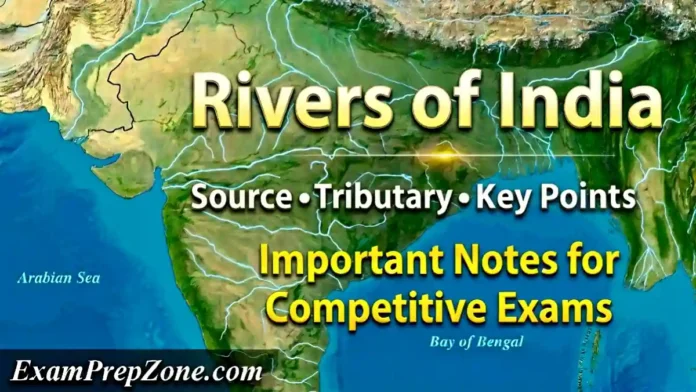
Major Rivers of India: Background & Key Discussion
One of the most important chapters in Indian Geography and Static GK is the Rivers of India. India’s civilization, culture, and economy have primarily developed around these river systems. In competitive exams like— SSC (CGL, CHSL, MTS, GD), Railways (RRB), Police (Constable & SI), WBCS, PSC Clerkship, Teaching Exams (Primary, Upper Primary, SLST, CTET), and other government job exams, several questions are asked every year regarding the origin, mouth, tributaries, and cities located on the banks of these rivers. In today’s Study Notes on Indian Rivers, we will discuss the major rivers of North and South India in detail, which will help strengthen your exam preparation.
Rivers of North India
The major river systems of North India primarily originate from the Himalayas. These rivers are perennial (flow throughout the year). Detailed information about the Indus, Ganga, and Brahmaputra rivers is given below:
Indus River
- River Name: Indus
- Origin: Sengge Zangbo spring or Chemayungdung glacier near Mansarovar Lake in Tibet.
- Tributaries:
- Left Bank: Jhelum, Chenab, Ravi, Beas, Sutlej (these five together form the Panjnad), Zanskar, Suru.
- Right Bank: Shyok, Gilgit, Kabul, Kurram, Gomal, Hunza.
- Distributaries: There are no significant distributaries of the Indus in India. However, before falling into the Arabian Sea near Karachi in Pakistan, it forms a vast delta and divides into several branches such as Haidri, Kalri, Okaho, and Nala Bani.
- Mouth: Arabian Sea.
- Important Facts:
- The Indus Waters Treaty was signed between India and Pakistan in 1960.
- The total length of the Indus River is 2,880 km, of which about 1,114 km flows through India.
- The city of Leh in Ladakh is situated on the right bank of the Indus River.
Ganga River
- River Name: Ganga
- Origin: Gaumukh ice cave of Gangotri Glacier in Uttarakhand.
- Tributaries:
- Left Bank: Ramganga, Gomti, Ghaghara, Gandak, Kosi, Mahananda.
- Right Bank: Yamuna (longest tributary), Son, Damodar.
- Distributaries: Bhagirathi-Hooghly (India) and Padma (Bangladesh).
- Mouth: Bay of Bengal.
- Important Facts:
- It is the longest river in India (total length 2,525 km).
- In 2008, the Ganga was declared the ‘National River’ of India.
- Ganga and Brahmaputra together form the Sundarbans, the world’s largest delta.
Brahmaputra River
- River Name: Brahmaputra
- Origin: Chemayungdung glacier near Mansarovar in Tibet.
- Tributaries:
- Left Bank: Lohit, Dhansiri, Dibang.
- Right Bank: Subansiri, Kameng, Manas, Teesta.
- Distributaries: Jamuna (after entering Bangladesh).
- Mouth: Bay of Bengal.
- Important Facts:
- In Tibet, this river is known as ‘Tsangpo’ and in Arunachal Pradesh, it is called ‘Dihang’.
- ‘Majuli’, located in the Brahmaputra River, is the world’s largest river island.
- It is an international river flowing through China (Tibet), India, and Bangladesh.
Rivers of South India
The rivers of South India can be divided into two main categories based on their direction of flow—East Flowing and West Flowing.
A. East Flowing Rivers
Mahanadi
- River Name: Mahanadi
- Origin: Sihawa highlands in Raipur district, Chhattisgarh.
- Tributaries: Seonath, Hasdeo, Mand, Ib, Tel.
- Distributaries: Kathjuri, Birupa (in Odisha).
- Mouth: Bay of Bengal.
- Important Facts:
- The famous Hirakud Dam in Odisha is located on this river.
- This river is known as the ‘Lifeline of Odisha’.
- It flows through the states of Chhattisgarh and Odisha.
Godavari
- River Name: Godavari
- Origin: Trimbak highlands or Trimbakeshwar in Nashik district, Maharashtra.
- Tributaries: Penganga, Wainganga, Wardha, Indravati, Manjira, Pranhita.
- Distributaries: Gautami Godavari and Vashishta Godavari.
- Mouth: Bay of Bengal.
- Important Facts:
- It is the longest river in South India (Length 1,465 km).
- This river is called ‘Dakshin Ganga’ or ‘Vriddha Ganga’ (Old Ganges).
- The city of Nashik is located on the banks of this river.
Krishna
- River Name: Krishna
- Origin: Mahabaleshwar in the Western Ghats of Maharashtra.
- Tributaries: Tungabhadra, Koyna, Ghatprabha, Malprabha, Musi, Bhima.
- Distributaries: No significant distributaries for the Krishna River.
- Mouth: Bay of Bengal.
- Important Facts:
- It is the second longest river in South India.
- The famous Nagarjuna Sagar Dam in Andhra Pradesh is built on this river.
- The city of Vijayawada is situated on the banks of the Krishna River.
Cauvery
- River Name: Cauvery (Kaveri)
- Origin: Talakaveri in the Brahmagiri hills of Kodagu district, Karnataka.
- Tributaries: Hemavati, Shimsha, Arkavati, Bhavani, Kabini, Amaravati.
- Distributaries: Kollidam (Coleroon) and Cauvery.
- Mouth: Bay of Bengal.
- Important Facts:
- Due to its sanctity, it is called the ‘Ganga of South India’.
- The famous Shivanasamudra Falls is located on this river.
- There is a long-standing dispute between Karnataka and Tamil Nadu over the sharing of Cauvery river water.
B. West Flowing Rivers
Narmada
- River Name: Narmada
- Origin: Amarkantak peak of Maikal Mountain in Madhya Pradesh.
- Tributaries: Orsang, Tawa, Hiran, Burner.
- Distributaries: None.
- Mouth: Gulf of Khambhat (Arabian Sea).
- Important Facts:
- It flows through a Rift Valley.
- The famous Dhuandhar Falls and Sardar Sarovar Dam are located on the Narmada River.
- It is the longest among the west-flowing rivers.
Tapi/Tapti
- River Name: Tapi/Tapti
- Origin: Multai highlands of the Satpura Range in Betul district, Madhya Pradesh.
- Tributaries: Purna, Girna, Bori, Panjhara.
- Distributaries: None.
- Mouth: Gulf of Khambhat (Arabian Sea).
- Important Facts:
- The city of Surat is situated on the banks of this river.
- Like the Narmada, this river also flows through a Rift Valley.
- The Ukai hydroelectric project is located on it.
Sabarmati & Mahi
- River Name: Sabarmati & Mahi
- Origin: Sabarmati originates from the Aravalli Range in Rajasthan; Mahi originates from the Vindhya Range.
- Tributaries: Watrak, Hatmati (Sabarmati); Panam, Bhadar (Mahi).
- Mouth: Gulf of Khambhat (Arabian Sea).
- Important Facts:
- Ahmedabad city is situated on the banks of the Sabarmati River.
- The Mahi River crosses the Tropic of Cancer twice.
- These are very important rivers of Gujarat.
Inland Rivers
Rivers that originate within a country’s boundaries but end in a lake or desert instead of reaching the sea are called inland rivers. The main inland rivers of India are discussed below:
Luni (Luni River)
- River Name: Luni
- Origin: Ana Sagar Lake or Pushkar Valley in the Aravalli Range near Ajmer, Rajasthan.
- Tributaries: Sukri, Mithari, Jawai, Bandi.
- Distributaries: None.
- Mouth: Rann of Kutch (Gujarat).
- Important Facts:
- It is the primary inland river of India.
- The water is sweet at the beginning of the flow, but it becomes saline after Balotra.
- Being an important river of the desert region, it is called the ‘Ganga of the Desert’.
Other Small Inland Rivers
- Ghaggar: It is a seasonal inland river that originates from the Shivalik Hills of Himachal Pradesh and disappears into the desert of Rajasthan.
- Medha and Roopnagar rivers originate from the Aravalli and fall into the Sambhar Lake.
Rivers of India: Quick Facts
Some very important information regarding Indian rivers that is highly effective for competitive exams:
- Longest River of India: Ganga (2,525 km).
- Longest Tributary of India: Yamuna (tributary of Ganga).
- Longest River of South India: Godavari (1,465 km).
- National River of India: Ganga (declared in 2008).
- Who is called ‘Vriddha Ganga’: Godavari River.
- Who is called ‘Ganga of South India’: Cauvery River (in terms of purity).
- The only saline river in India: Luni River.
- Crosses Tropic of Cancer twice: Mahi River.
- Longest among west-flowing rivers: Narmada River.
- World’s largest river island: Majuli (located on the Brahmaputra River).
- Highest dam in India: Tehri Dam (on Bhagirathi River).
- Longest dam in India: Hirakud Dam (on Mahanadi River).
- Sorrow of Bihar: Kosi River.
- Sorrow of Bengal: Damodar River.
- Which rivers flow through a Rift Valley: Narmada and Tapti.
People also ask (FAQs)
Which is the longest river in India?
The Ganga is the longest river in India. Its total length is 2,525 km.
Which is the longest river in South India?
Godavari is the longest river in South India. It is also called ‘Dakshin Ganga’ or ‘Vriddha Ganga’.
Which is the only primary inland river of India?
Luni is the main inland river of India, which originates from Ajmer in Rajasthan and ends in the Rann of Kutch in Gujarat.
Which river crosses the Tropic of Cancer twice?
The Mahi river in India crosses the Tropic of Cancer twice.
Which Indian rivers flow through a Rift Valley?
The Narmada and Tapti rivers flow through the Rift Valley of India and fall into the Arabian Sea.
Which is the world’s largest river delta?
The Ganga and Brahmaputra rivers together form the ‘Sundarbans’, the world’s largest delta.
📌 Smart Study Tips: Rivers of India
Remembering the Rivers of India can be quite challenging for competitive exams. Follow these tips to master this topic easily:
- Use Maps: To remember the flow of rivers, practice by drawing the rivers on a blank map of India. This will help you remember the tributaries and mouths for a long time.
- Mnemonics or Shortcut Tricks: For example—to remember the left bank tributaries of the Ganga, you can use the “RG3 KM” (Ramganga, Gomti, Ghaghara, Gandak, Kosi, Mahananda) formula.
- Comparative Charts: Create a table showing the differences between North and South Indian rivers, and East-flowing versus West-flowing rivers.
- Frequent Revision: Many questions come from origins and riverside cities in SSC and Railways, so check this chart at least once a week.
🌟 Message for Success: Remember, proper preparation and consistency are the only keys to success. Exam Prep Zone is always by your side. To strengthen your exam preparation, check out all our Important Static GK Study Notes—where every topic is presented simply for exam purposes.