States and Union Territories of India: Background & Important Overview
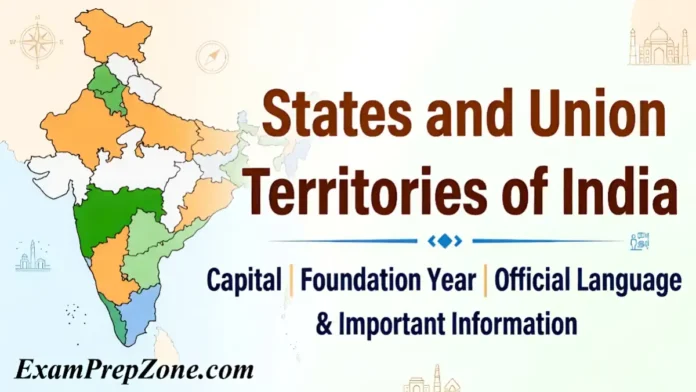
India is the world’s largest democratic nation and a diverse country in South Asia. For administrative convenience and to maintain unity in diversity, India has been divided into various States and Union Territories. Currently, there are a total of 28 States and 8 Union Territories in India. Although each state has its own history, culture, and administrative structure, they are all an integral part of an undivided India.
For the preparation of any competitive exam, it is essential to have a clear understanding of this administrative map of India. Questions from this chapter are frequently asked in various government job exams, including SSC (CGL, CHSL, MTS, GD), Railways (RRB), Police (Constable & SI), WBCS, PSC Clerkship, Teaching Exams (Primary, Upper Primary, SLST, CTET), and Banking. In today’s post, we will discuss in detail the Capital, Foundation Date, and the special geographical position of each State and Union Territory of India.
Detailed List of 28 States of India
State Name: Andhra Pradesh
Capital: AmaravatiFoundation Year: 1 November 1956
Official Language: Telugu
Quick Facts:
- Andhra Pradesh was the first state in India to be formed on a linguistic basis.
- It is known as the “Rice Bowl of India” due to its high rice production.
- The world-famous Koh-i-Noor diamond is historically associated with this state.
State Name: Arunachal Pradesh
Capital: ItanagarFoundation Year: 20 February 1987
Official Language: English, Nyishi
Quick Facts:
- Located in the extreme east of India, it is called the “Land of the Rising Sun.”
- The Tawang Monastery in this state is the largest Buddhist monastery in India.
- Due to its natural beauty, it is also known as the “Orchid State of India.”
State Name: Assam
Capital: DispurFoundation Year: 26 January 1950
Official Language: Assamese
Quick Facts:
- The world-famous Kaziranga National Park is located in this state.
- Kamakhya Temple in Assam is a major pilgrimage site for Hindus.
- The state is globally recognized for its high-quality tea production.
State Name: Bihar
Capital: PatnaFoundation Year: 26 January 1950
Official Language: Hindi
Quick Facts:
- Nalanda University, an ancient center of learning, was located in this state.
- Gautam Buddha attained enlightenment in Bodh Gaya, making it a key Buddhist site.
- Bihar is one of the leading states in India in terms of population density.
State Name: Chhattisgarh
Capital: RaipurFoundation Year: 1 November 2000
Official Language: Hindi, Chhattisgarhi
Quick Facts:
- This state was formed by separating from Madhya Pradesh for administrative ease.
- The Chitrakote Falls, known as the “Niagara Falls of India,” is located here.
- The state is a vital region rich in minerals and dense forest cover.
State Name: Goa
Capital: PanajiFoundation Year: 30 May 1987
Official Language: Konkani
Quick Facts:
- It is the smallest state in India in terms of geographical area.
- The region remained under Portuguese rule until 1961.
- Goa is globally admired for its beautiful beaches and vibrant tourism.
State Name: Gujarat
Capital: GandhinagarFoundation Year: 1 May 1960
Official Language: Gujarati
Quick Facts:
- Gujarat has the longest coastline among all Indian states.
- It is the birthplace of Mahatma Gandhi and Sardar Vallabhbhai Patel.
- Gir National Park is the only natural habitat for Asiatic lions.
State Name: Haryana
Capital: ChandigarhFoundation Year: 1 November 1966
Official Language: Hindi, Haryanvi
Quick Facts:
- The legendary battlefield of Kurukshetra from the Mahabharata is located here.
- It is known as the “Milk Pail of India” due to its high milk production.
- The state is one of the most advanced in India in agriculture and livestock.
State Name: Himachal Pradesh
Capital: ShimlaFoundation Year: 25 January 1971
Official Language: Hindi, Pahari
Quick Facts:
- Nestled in the Himalayas, this state is famously called the “Apple State.”
- Dharamshala is the current residence of the Tibetan spiritual leader, the Dalai Lama.
- It is one of India’s most popular hill station and tourism destinations.
State Name: Jharkhand
Capital: RanchiFoundation Year: 15 November 2000
Official Language: Hindi
Quick Facts:
- Known as the “Ruhr of India” due to its vast coal and iron ore reserves.
- It was previously part of Bihar and became a separate state in 2000.
- Ranchi is the hometown of the legendary cricketer Mahendra Singh Dhoni.
State Name: Karnataka
Capital: BengaluruFoundation Year: 1 November 1956
Official Language: Kannada
Quick Facts:
- The capital city, Bengaluru, is famously known as the “Silicon Valley of India.”
- The state ranks first in India in terms of coffee production.
- Historical Hampi and the Mysore Palace are the major attractions of this state.
State Name: Kerala
Capital: ThiruvananthapuramFoundation Year: 1 November 1956
Official Language: Malayalam
Quick Facts:
- Kerala has the highest literacy rate among all states in India.
- Due to its breathtaking natural beauty, it is called “God’s Own Country.”
- It is known as the “Spice Garden of India” for its diverse spice production.
State Name: Madhya Pradesh
Capital: BhopalFoundation Year: 1 November 1956
Official Language: Hindi
Quick Facts:
- Located in the center of the country, it is called the “Heart of India.”
- It is known as the “Tiger State” for having the highest number of tigers.
- Khajuraho Temples and Sanchi Stupa are its major historical monuments.
State Name: Maharashtra
Capital: MumbaiFoundation Year: 1 May 1960
Official Language: Marathi
Quick Facts:
- Mumbai, its capital, is known as the “Financial Capital of India.”
- The famous Ajanta and Ellora cave paintings are located in this state.
- Maharashtra is a major hub for Indian industry and the film world.
State Name: Manipur
Capital: ImphalFoundation Year: 21 January 1972
Official Language: Meitei
Quick Facts:
- Loktak Lake and the floating Keibul Lamjao National Park are located here.
- The state is considered the ancestral birthplace of the game of Polo.
- Manipuri classical dance is one of India’s major traditional dance forms.
State Name: Meghalaya
Capital: ShillongFoundation Year: 21 January 1972
Official Language: Khasi, Garo, English
Quick Facts:
- Mawsynram, the place with the highest rainfall in the world, is located here.
- Shillong is often called the “Scotland of the East” for its natural beauty.
- Its name means “Abode of Clouds” due to the constant presence of clouds.
State Name: Mizoram
Capital: AizawlFoundation Year: 20 February 1987
Official Language: Mizo, English
Quick Facts:
- Mizoram is one of the top Indian states in terms of literacy rate.
- The famous Bamboo Dance or Cheraw Dance of this state is globally renowned.
- It is a hilly state located in the extreme southeastern part of India.
State Name: Nagaland
Capital: KohimaFoundation Year: 1 December 1963
Official Language: English
Quick Facts:
- It is called the “Land of Festivals,” with the Hornbill Festival being the main one.
- Mount Saramati in Nagaland is the highest peak in the state.
- It is a very important tribal-dominated area in Northeast India.
State Name: Odisha
Capital: BhubaneswarFoundation Year: 26 January 1950
Official Language: Odia
Quick Facts:
- The famous Jagannath Temple of Puri and Konark Sun Temple are located here.
- Chilika, the largest saltwater lake in India, is situated in Odisha.
- Odissi dance is one of India’s most ancient and classical dance forms.
State Name: Punjab
Capital: ChandigarhFoundation Year: 1 November 1966
Official Language: Punjabi
Quick Facts:
- The region is named Punjab because it is the meeting point of five rivers.
- The world-famous Golden Temple of Amritsar is located in this state.
- Due to the Green Revolution, Punjab has become a major granary of India.
State Name: Rajasthan
Capital: JaipurFoundation Year: 26 January 1950
Official Language: Hindi, Rajasthani
Quick Facts:
- Rajasthan is the largest Indian state in terms of geographical area.
- The Thar Desert covers a vast part of this state’s landscape.
- Jaipur is known as the “Pink City” due to its distinct pink architecture.
State Name: Sikkim
Capital: GangtokFoundation Year: 16 May 1975
Official Language: Nepali, English
Quick Facts:
- Sikkim is the first fully organic state in India.
- Kanchenjunga, the highest peak in India, is located in Sikkim.
- It is known as the smallest state in India in terms of population.
State Name: Tamil Nadu
Capital: ChennaiFoundation Year: 26 January 1950
Official Language: Tamil
Quick Facts:
- Marina Beach in Chennai is the longest natural sea beach in India.
- Tamil Nadu is the original birthplace of the famous Bharatanatyam dance.
- The state is known for its temple architecture and holds many ancient temples.
State Name: Telangana
Capital: HyderabadFoundation Year: 2 June 2014
Official Language: Telugu, Urdu
Quick Facts:
- It was formed by separating from Andhra Pradesh as India’s youngest state.
- The historic Charminar and Golconda Fort are major landmarks of this state.
- Hyderabad city is currently known as a major technology hub in India.
State Name: Tripura
Capital: AgartalaFoundation Year: 21 January 1972
Official Language: Bengali, Kokborok
Quick Facts:
- This state is surrounded on three sides by the neighboring country Bangladesh.
- Ujjayanta Palace and Neermahal are key royal monuments of this state.
- Tripura is one of India’s smallest hilly states in terms of area.
State Name: Uttar Pradesh
Capital: LucknowFoundation Year: 24 January 1950
Official Language: Hindi
Quick Facts:
- Uttar Pradesh is the largest state in India in terms of population.
- The Taj Mahal, one of the seven wonders of the world, is located in Agra.
- Varanasi is considered one of the oldest living cities in the world.
State Name: Uttarakhand
Capital: DehradunFoundation Year: 9 November 2000
Official Language: Hindi, Sanskrit
Quick Facts:
- It is called “Devbhumi” due to the presence of numerous holy shrines.
- Jim Corbett, the first national park in India, is located in this state.
- The Ganga and Yamuna rivers originate from the Himalayas in Uttarakhand.
State Name: West Bengal
Capital: KolkataFoundation Year: 26 January 1950
Official Language: Bengali
Quick Facts:
- The Sundarbans, the world’s largest delta, is located in West Bengal.
- Kolkata is known as the “Cultural Capital of India” and the “City of Joy.”
- The Darjeeling Himalayan Railway holds UNESCO World Heritage status.
Detailed List of 8 Union Territories of India
Name of Union Territory: Andaman and Nicobar Islands
Capital: Port BlairFoundation Year: 1 November 1956
Official Language: Hindi, English
Quick Facts:
- Located in the Bay of Bengal, these islands are a very important strategic region for India.
- India’s only active volcano, ‘Barren Island’, is located in this Union Territory.
- The Cellular Jail here is an inseparable part of the history of India’s independence struggle.
Name of Union Territory: Chandigarh
Capital: ChandigarhFoundation Year: 1 November 1966
Official Language: English, Punjabi, Hindi
Quick Facts:
- Chandigarh is a planned city in India designed by the architect Le Corbusier.
- It serves as the joint capital of both Punjab and Haryana states.
- The city’s famous Rock Garden is a major attraction for tourists.
Name of Union Territory: Dadra and Nagar Haveli and Daman and Diu
Capital: DamanFoundation Year: 26 January 2020 (Merger)
Official Language: Gujarati, Hindi, Konkani
Quick Facts:
- In 2020, two separate Union Territories were merged for administrative convenience.
- This region was under Portuguese rule for a long time, and their architectural influence can be seen here.
- Daman and Diu are very popular among tourists for their beautiful beaches and peaceful environment.
Name of Union Territory: Delhi (National Capital Territory)
Capital: New DelhiFoundation Year: 1 November 1956
Official Language: Hindi, Punjabi, Urdu
Quick Facts:
- Delhi is the political center of India and is an ancient historical city.
- Located on the banks of the Yamuna River, this city houses the Red Fort, Qutub Minar, and India Gate.
- In 1911, during the British era, the capital of India was shifted from Calcutta to Delhi.
Name of Union Territory: Jammu and Kashmir
Capital: Srinagar (Summer), Jammu (Winter)Foundation Year: 31 October 2019
Official Language: Kashmiri, Dogri, Urdu, Hindi
Quick Facts:
- After the revocation of Article 370 in 2019, it was converted from a state to a Union Territory.
- The Dal Lake and houseboats here are very popular among tourists worldwide.
- Due to its abundance of natural beauty, this region is called the “Paradise on Earth.”
Name of Union Territory: Ladakh
Capital: Leh (Summer), Kargil (Winter)Foundation Year: 31 October 2019
Official Language: Ladakhi, Tibetan, Hindi
Quick Facts:
- It is currently known as the largest Union Territory of India.
- The cold deserts and high mountain passes here are the primary targets for adventure-loving tourists.
- Pangong Lake is one of the major natural and tourist attractions of this region.
Name of Union Territory: Lakshadweep
Capital: KavarattiFoundation Year: 1 November 1956
Official Language: Malayalam, English
Quick Facts:
- It is the smallest Union Territory of India in terms of area.
- Located in the Arabian Sea, this archipelago is famous for its coral reefs.
- To protect the environment, tourist access to many islands here is restricted.
Name of Union Territory: Puducherry
Capital: PuducherryFoundation Year: 1 November 1954
Official Language: Tamil, French, English
Quick Facts:
- Puducherry was a French colony for a long time, the influence of which is clear in its culture.
- The four districts of this Union Territory are spread across three different states of India.
- Sri Aurobindo Ashram and Auroville are famous as spiritual and tourist centers here.
States and Union Territories of India: Quick Facts
Largest State by Area: Rajasthan.
Smallest State by Area: Goa.
Largest State by Population: Uttar Pradesh.
Smallest State by Population: Sikkim.
State with Highest Literacy Rate: Kerala.
State with Lowest Literacy Rate: Bihar.
Youngest State of India: Telangana (Formed on 2 June 2014).
First State formed on Linguistic Basis: Andhra Pradesh (1956).
State with the Longest Coastline: Gujarat.
Largest Union Territory by Area: Ladakh.
Smallest Union Territory by Area: Lakshadweep.
Largest Union Territory by Population: Delhi.
State where India’s Highest Peak is located: Sikkim (Kanchenjunga).
State surrounded by Bangladesh on three sides: Tripura.
Which state is called the ‘Tiger State’: Madhya Pradesh.
Last State liberated from Portuguese rule: Goa (1961).
Which city is called the ‘Pink City’: Jaipur (Rajasthan).
Which state is called the ‘Spice Garden of India’: Kerala.
People also ask (FAQs)
How many States and Union Territories are there in India currently?
Currently, there are a total of 28 States and 8 Union Territories in India.
Which is the youngest or 28th state of India?
Telangana is the youngest or 28th state of India, which was formed on 2 June 2014, by bifurcating Andhra Pradesh.
Which are the largest and smallest states of India?
In terms of area, the largest state in India is Rajasthan and the smallest state is Goa.
Which Indian state was the first to be formed on a linguistic basis?
Andhra Pradesh was the first state in India to be formed on a linguistic basis in 1956.
Which are the largest and smallest Union Territories of India?
Currently, in terms of area, the largest Union Territory of India is Ladakh and the smallest Union Territory is Lakshadweep.
Which Indian state is surrounded by Bangladesh on three sides?
The state of Tripura in India is surrounded by the neighboring country Bangladesh on three sides.
📌 Smart Study Tips: States and Union Territories of India
You can follow the smart tips below to easily remember the chapter on States and Union Territories of India:
- Keep a political map of India nearby and match the geographical positions of the states while studying.
- Along with the list of states and capitals, make notes of which states share borders with India’s neighboring countries.
- Write down the dates of the formation of the newest states and union territories separately, as these are frequently asked in current exams.
- Regularly revise the topic of States and Union Territories of India so that you do not forget the important facts.
🌟 Message of Success: Remember, hard work and proper planning are the keys to success. Today’s small preparations will lead you to great success tomorrow. We regularly update Chapter-wise Study Materials like this on our website. To strengthen your exam preparation, check out all our Important Static GK Study Notes—where every topic is presented simply for exam purposes.