
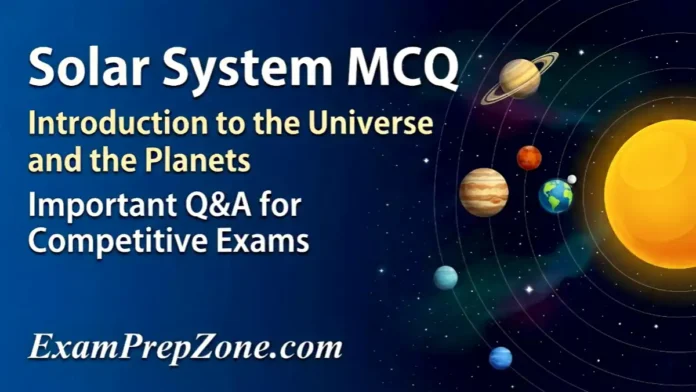
Solar System MCQ: Introduction to the Universe & the Planets

Share
Select Language: English हिन्दी বাংলা

Solar System MCQs: Introduction to the Universe and the Planets Important Q&A

The Solar System is a vast family of the Sun and everything that orbits it, including planets, moons, asteroids, and comets. In this mysterious realm of space, there are eight (8) major planets, among which Earth is the only one known to sustain life. Each planet has its own unique characteristics, rotational speed, and satellites, making it an essential chapter for the General Knowledge or Geography section of competitive exams.

To excel in exams, it is crucial to have a clear understanding of Solar System MCQs and the positions and features of planets. From Mercury, the closest planet to the Sun, to Neptune, the farthest, students must remember the details of every celestial body accurately. In this Solar System MCQ series, we have selected questions that have appeared repeatedly in various previous years’ exams and are highly effective for upcoming tests.

INFO

Rules to View the Correct Answer

Each question has four options. Click the “Show Answer” button below to see the correct answer.
(Note: Clicking for the 2nd time will Hide the answer, and clicking for the 3rd time will show it again.)

Solar System MCQs: 20 Important Questions and Answers for Competitive Exams

1. Which is the largest planet in our solar system?
(A) Mars
(B) Jupiter
(C) Saturn
(D) Earth
Correct Answer: (B) Jupiter Extra Info: It is about 1300 times larger than Earth in volume. It has an extremely strong gravitational force and is primarily composed of various gases. The famous ‘Great Red Spot’ on this planet is actually a massive storm.
2. Which is the closest planet to the Sun?
(A) Venus
(B) Mars
(C) Mercury
(D) Earth
Correct Answer: (C) Mercury Extra Info: It is the smallest and closest planet to the Sun in the solar system. Due to its proximity to the Sun, its daytime temperatures are extremely high. This planet has no atmosphere or any natural satellites.
3. Which planet is known as the ‘Red Planet’?
(A) Mars
(B) Venus
(C) Jupiter
(D) Saturn
Correct Answer: (A) Mars Extra Info: It appears red due to the presence of iron oxide (rust) on its surface. ‘Olympus Mons’, the largest volcano in the solar system, is located on this planet. Scientists have found evidence of liquid water existing here in the past.
4. Which is the hottest planet in the solar system?
(A) Mercury
(B) Venus
(C) Earth
(D) Mars
Correct Answer: (B) Venus Extra Info: Although Mercury is closer to the Sun, Venus is the hottest planet. Its atmosphere contains vast amounts of carbon dioxide, leading to an extreme greenhouse effect. Venus rotates from East to West on its axis.
5. Which planet has the brightest and most distinct rings?
(A) Jupiter
(B) Uranus
(C) Neptune
(D) Saturn
Correct Answer: (D) Saturn Extra Info: Saturn has seven main rings made of ice and dust particles. Among the planets, Saturn has the lowest density. Currently, Saturn holds the record for the highest number of moons in the solar system.
6. Which planet is called the ‘Blue Planet’?
(A) Neptune
(B) Earth
(C) Uranus
(D) Venus
Correct Answer: (B) Earth Extra Info: Earth appears blue from space due to the presence of vast water bodies. It is the only planet in the solar system where life is known to exist. Approximately 71% of Earth’s surface is covered by water.
7. Exactly how long does Earth take to orbit the Sun?
(A) 360 days
(B) 365 days
(C) 367 days
(D) 364 days
Correct Answer: (B) 365 days 5 hours 48 minutes 46 seconds Extra Info: This is known as Earth’s annual motion or solar year. To adjust for this extra time, an extra day is added to February every four years, creating a Leap Year. Earth’s annual motion causes the change of seasons.
8. Titan is the largest moon of which planet?
(A) Jupiter
(B) Saturn
(C) Mars
(D) Neptune
Correct Answer: (B) Saturn Extra Info: It is the second-largest moon in the solar system and has its own dense atmosphere. It is larger in size than the planet Mercury. Scientists believe there are rivers and lakes of liquid methane on Titan’s surface.
9. In which year was Halley’s Comet last seen?
(A) 1976
(B) 1986
(C) 1996
(D) 2006
Correct Answer: (B) 1986 Extra Info: It is visible from Earth every 76 years. It is expected to be visible again in the year 2061. Edmond Halley was the first to determine the orbital period of this comet.
10. Which is the coldest planet in the solar system?
(A) Neptune
(B) Uranus
(C) Saturn
(D) Pluto
Correct Answer: (B) Uranus Extra Info: Although Neptune is further from the Sun, Uranus has the coldest atmosphere. Its average temperature is about minus 224 degrees Celsius. This planet is often referred to as an ‘Ice Giant’.
11. What are the names of the two moons of Mars?
(A) Titan and Moon
(B) Phobos and Deimos
(C) Ganymede and Callisto
(D) Io and Europa
Correct Answer: (B) Phobos and Deimos Extra Info: Phobos is slowly moving toward Mars and may crash into the planet in the future. These two moons are small and irregular in shape. They were likely asteroids trapped by Mars’ gravity.
12. Approximately how long does sunlight take to reach Earth?
(A) 5 minutes 20 seconds
(B) 10 minutes 18 seconds
(C) 8 minutes 20 seconds
(D) 12 minute 18 seconds
Correct Answer: (C) 8 minutes 20 seconds Extra Info: Light travels at a speed of about 300,000 kilometers per second. The average distance from the Sun to Earth is about 150 million kilometers. This time increases slightly when Earth is at Aphelion.
13. Which is the largest moon in the solar system?
(A) Moon
(B) Titan
(C) Ganymede
(D) Callisto
Correct Answer: (C) Ganymede Extra Info: It is a moon of Jupiter and is larger in size than the planet Mercury. It has its own magnetic field, which no other moon possesses. Ganymede’s surface is mainly composed of ice and silicate rock.
14. Which planet is called the ‘Morning Star’ or ‘Evening Star’?
(A) Mars
(B) Venus
(C) Saturn
(D) Mercury
Correct Answer: (B) Venus Extra Info: It is the brightest planet in the sky, visible in the East before sunrise and in the West after sunset. Due to its brightness, ancient people mistook it for a star. Venus is also called Earth’s ‘Twin Planet’.
15. Which galaxy does the Sun belong to?
(A) Andromeda
(B) Milky Way
(C) Messier 81
(D) Sombrero
Correct Answer: (B) Milky Way Extra Info: Our galaxy is a spiral-shaped galaxy. Millions of such galaxies exist in space. The Sun is located about 27,000 light-years away from the center of the Milky Way.
16. Which planet rotates from East to West on its axis?
(A) Earth
(B) Mars
(C) Venus
(D) Jupiter
Correct Answer: (C) Venus Extra Info: While most planets rotate from West to East, Venus and Uranus rotate in the opposite direction. Consequently, the Sun rises in the West on Venus. One day on Venus (about 243 Earth days) lasts longer than its year (about 225 Earth days).
17. Which was the first animal sent into space?
(A) Monkey
(B) Cat
(C) Dog
(D) Rat
Correct Answer: (C) Dog Extra Info: In 1957, the Soviet Union sent a dog named ‘Laika’ aboard the Sputnik 2 spacecraft. This was a major milestone in the history of space research. Laika was the first living creature to orbit the Earth.
18. Between which two planets is the Asteroid Belt located?
(A) Earth and Mars
(B) Mars and Jupiter
(C) Jupiter and Saturn
(D) Saturn and Uranus
Correct Answer: (B) Mars and Jupiter Extra Info: Millions of small and large asteroids orbit the Sun in this region. Scientists believe these were the building blocks of a planet that never formed due to Jupiter’s strong gravity. ‘Ceres’ is the largest object in this belt and is now classified as a dwarf planet.
19. What is the only natural satellite of Earth?
(A) Moon
(B) Sun
(C) Titan
(D) Phobos
Correct Answer: (A) Moon Extra Info: It is the closest celestial body to Earth and takes about 27.3 days to orbit the Earth. The Moon has no light of its own; it shines by reflecting sunlight. The Moon’s gravitational pull is the primary cause of tides on Earth.
20. What is Pluto currently classified as?
(A) Major Planet
(B) Satellite
(C) Dwarf Planet
(D) Comet
Correct Answer: (C) Dwarf Planet Extra Info: In 2006, the International Astronomical Union (IAU) reclassified Pluto as a dwarf planet. This decision was based on its small size and its failure to clear its orbital neighborhood. Pluto’s largest moon is named Charon.

People also ask (FAQs)

What is the Solar System?

The Solar System is a vast family consisting of the Sun and everything that orbits it, including planets, satellites (moons), asteroids, comets, and cosmic dust.

How was the Solar System formed?

According to scientists, the Solar System formed about 4.6 billion years ago from a massive rotating cloud of gas and dust in space. Under the influence of gravity, this cloud collapsed, giving birth to the Sun at its center, while the remaining material formed the planets and other celestial bodies.

Who first discovered the Solar System?

The modern model of the Solar System—where planets revolve around the Sun—was first clearly proposed by Nicolaus Copernicus in 1543. Later, Galileo Galilei and Johannes Kepler established this concept through their observations and mathematical laws.

What is the Solar System made of?

The Solar System is composed of one star (the Sun), 8 major planets, 5 dwarf planets, numerous satellites (like the Moon), the asteroid belt, comets, and interstellar gas and dust.

How many planets are in the Solar System and what are they?

There are 8 major planets in the Solar System. In order of their distance from the Sun, they are: Mercury, Venus, Earth, Mars, Jupiter, Saturn, Uranus, and Neptune.

Which is the farthest planet in the Solar System?

Neptune is the farthest planet in the Solar System. While Pluto was once considered the farthest planet, it is now classified as a dwarf planet.

📌 Smart Study Tips: Solar System MCQs – Introduction to the Universe & the Planets

Here are some Smart Study Tips to help you easily remember the Solar System chapter:

  • Create a mnemonic or rhyme to remember the distance of planets from the Sun, which will help you recall their names in order.
  • While practicing Solar System MCQs, make separate notes of the special names of each planet (e.g., Blue Planet – Earth, Red Planet – Mars, Morning Star – Venus).
  • Prepare a list of the largest and smallest planets and satellites and keep it in front of your study table, as questions are frequently asked from here.
  • Take regular online mock tests and revise the Solar System MCQs notes repeatedly to avoid confusion of facts.

🌟 Message for Success: Your hard work and the right guidelines can lead you to the pinnacle of success. Build your confidence through regular preparation. Like this Solar System MCQ session on our website, advance your preparation by regularly practicing our Geography Chapter-wise MCQs and Mock Tests.
Share

YOU MIGHT LIKE

LEAVE A COMMENT

Please enter your comment!
Please enter your name here.

START LEARNING BY SUBJECT

DON'T MISS

QUICK STUDY PICKS