
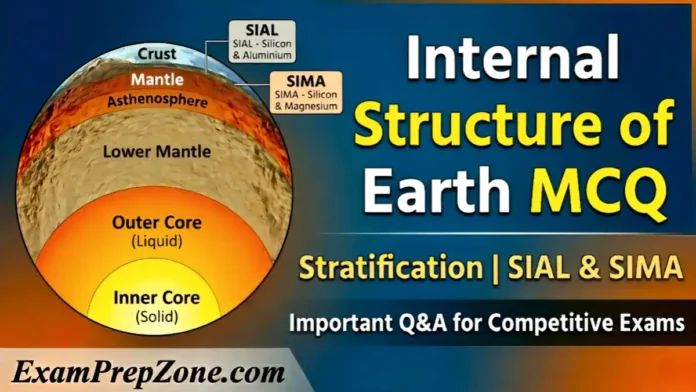
Internal Structure of Earth MCQ: Stratification, SIAL & SIMA

Share
Select Language: English हिन्दी বাংলা

Internal Structure of Earth MCQ: Layered Structure, SIAL and SIMA

Although the surface of our vast Earth beneath our feet is solid, its interior is divided into various layers based on depth. By observing the behavior of seismic waves, scientists have classified the Earth into three primary layers— Crust, Mantle, and Core. Each layer possesses distinct temperature, density, and chemical compositions, which play a crucial role in Earth’s geological changes and volcanic activities.

In competitive exam preparation, questions related to Discontinuity lines and mineral compositions of various layers (such as SIAL, SIMA) are frequently asked from the Internal Structure of Earth MCQ chapter. For the convenience of students, we have curated this informative Earth’s Interior MCQ session with questions and answers that will not only clear your concepts but also take your exam preparation to the next level.

INFO

Rules to View the Correct Answer

Each question has four options. Click the “Show Answer” button below to see the correct answer.
(Note: Clicking for the 2nd time will Hide the answer, and clicking for the 3rd time will show it again.)

Internal Structure of Earth MCQ: 20 Important Questions and Answers for Competitive Exams

1. What is the upper layer of the Earth’s crust called?
(A) SIMA
(B) SIAL
(C) NIFE
(D) MANTLE
Correct Answer: (B) SIAL Extra Info: This layer is called SIAL because it is composed of Silica and Aluminum. It primarily forms the continental crust. Granite rocks are the main component of this layer.
2. The oceanic crust is mainly composed of which rock?
(A) Granite
(B) Marble
(C) Basalt
(D) Limestone
Correct Answer: (C) Basalt Extra Info: The oceanic crust or SIMA layer is composed of heavy basaltic rocks. Silica and Magnesium are the main components of this layer. The density of the SIMA layer is much higher than that of the SIAL layer.
3. Which discontinuity lies between the Crust and the Mantle?
(A) Conrad
(B) Mohorovicic
(C) Gutenberg
(D) Lehmann
Correct Answer: (B) Mohorovicic (Moho) Extra Info: Scientist Andrija Mohorovicic discovered this line in 1909. It is located at the boundary between the crust and the mantle. The velocity of seismic waves increases abruptly below this line.
4. What is the approximate temperature at the Earth’s center in degrees Celsius?
(A) 2000
(B) 4000
(C) 6000
(D) 10000
Correct Answer: (C) 6000 Extra Info: The temperature of the Earth’s core is nearly equal to the surface temperature of the Sun. Due to extreme pressure, the inner core remains solid despite this high temperature. This intense heat is the primary source of Earth’s internal energy.
5. What is the discontinuity between the Mantle and the Core called?
(A) Gutenberg Discontinuity
(B) Repetti Discontinuity
(C) Conrad Discontinuity
(D) Lehmann Discontinuity
Correct Answer: (A) Gutenberg Discontinuity Extra Info: Scientist Beno Gutenberg identified this discontinuity in 1912. It is located about 2900 km below the Earth’s surface. This marks the end of the mantle and the beginning of the core.
6. The Core is mainly composed of which two minerals?
(A) Silica and Iron
(B) Nickel and Magnesium
(C) Nickel and Iron
(D) Aluminum and Copper
Correct Answer: (C) Nickel and Iron (NIFE) Extra Info: It is called ‘NIFE’ derived from the symbol for Nickel (Ni) and the Latin name for Iron, Ferrum (Fe). This layer consists of very heavy and dense minerals. These elements are responsible for Earth’s magnetism.
7. What are the main components of the Mantle?
(A) Iron and Nickel
(B) Iron and Magnesium
(C) Aluminum and Silica
(D) Aluminum and Copper
Correct Answer: (B) Iron and Magnesium Extra Info: The mantle accounts for about 84% of the Earth’s total volume. The upper part is known as Crofesima and the lower part as Nifeshima. Magma is predominantly found in this layer.
8. Which discontinuity is found between the SIAL and SIMA layers?
(A) Gutenberg
(B) Moho
(C) Conrad
(D) Lehmann
Correct Answer: (C) Conrad Extra Info: Scientist Victor Conrad proved the existence of this discontinuity in 1925. It separates the lighter SIAL of the continental crust from the heavier SIMA layer. This line is not prominent under ocean floors.
9. Asthenosphere is a part of which layer?
(A) Upper Mantle
(B) Lower Mantle
(C) Inner Core
(D) Crust
Correct Answer: (A) Upper Mantle Extra Info: It is a viscous or semi-liquid layer located just below the crust. Magma chambers are primarily located here. Convection currents in this layer are responsible for plate tectonics.
10. What is the approximate radius of the Earth in kilometers?
(A) 5371
(B) 6371
(C) 7371
(D) 8371
Correct Answer: (B) 6371 Extra Info: The average radius of the Earth is the distance from the surface to the exact center. Even the deepest mines are shallow compared to this vast distance. The thickness of each internal layer is determined based on this radius.
11. In what state is the Outer Core?
(A) Solid
(B) Gaseous
(C) Liquid
(D) Plasma
Correct Answer: (C) Liquid or Viscous Extra Info: Due to extreme heat, Nickel and Iron in this layer remain in a molten liquid state. The rotation of this liquid iron generates the Earth’s magnetic field. Seismic S-waves cannot pass through this layer.
12. What is the primary reason the Earth’s Inner Core is solid?
(A) Extreme cold
(B) Extreme pressure
(C) Lack of oxygen
(D) Presence of water
Correct Answer: (B) Extreme pressure Extra Info: Despite the very high temperature at the center, the core remains solid due to the immense pressure of the overlying mountains and soil. This pressure significantly raises the melting point of iron. This is the densest and heaviest layer.
13. Which discontinuity lies between Crofesima and Nifeshima?
(A) Repetti
(B) Moho
(C) Conrad
(D) Gutenberg
Correct Answer: (A) Repetti Extra Info: It separates the upper mantle (Crofesima) from the lower mantle (Nifeshima). This line is located about 700 km below the surface. It was discovered by scientist William Repetti.
14. What does the Lithosphere refer to?
(A) Crust and Inner Core
(B) Crust and Upper Mantle
(C) Oceanic floor only
(D) Inner Core only
Correct Answer: (B) Crust and solid part of Upper Mantle Extra Info: This layer extends up to a depth of about 100 km from the surface. It is composed of solid and brittle rocks. The tectonic plates we know are part of this lithosphere.
15. Which discontinuity is located between the Outer Core and Inner Core?
(A) Gutenberg
(B) Moho
(C) Lehmann
(D) Repetti
Correct Answer: (C) Lehmann Extra Info: Danish scientist Inge Lehmann discovered this discontinuity in 1936. It separates the liquid outer core from the solid inner core. It is located approximately 5150 km below the surface.
16. By how much does the temperature increase for every 32 meters of depth inside the Earth?
(A) 1°C
(B) 5°C
(C) 10°C
(D) 32°C
Correct Answer: (A) 1°C Extra Info: Temperature increases as we go deeper into the Earth. However, the rate of increase gradually slows down with depth. This rise in temperature makes working in deep mines very difficult.
17. What percentage of Earth’s total volume is the Crust?
(A) Less than 1%
(B) 10%
(C) 50%
(D) 80%
Correct Answer: (A) Less than 1% Extra Info: The Earth’s crust is often compared to the shell of an egg. The mantle accounts for 84% and the core for about 15% of the rest. It is the thinnest layer of the Earth.
18. How does the outer core contribute to Earth’s magnetism?
(A) Through the stagnation of iron
(B) Through convection currents of liquid iron
(C) By collecting energy from space
(D) By the heat of the Sun
Correct Answer: (B) Through convection currents of liquid iron Extra Info: This is known as the ‘Geo-dynamo’. These currents of liquid iron generate electrical energy that creates a strong magnetic field around the Earth. This magnetic field protects our Earth from harmful solar radiation.
19. Which wave has the highest velocity inside the Earth?
(A) S-wave
(B) L-wave
(C) P-wave
(D) Ocean wave
Correct Answer: (C) P-wave Extra Info: Primary or P-waves can travel through solid, liquid, and gaseous media. It is the fastest seismic wave. Geoscientists understand the Earth’s internal structure by observing changes in the velocity of these waves.
20. At what depth is the Nifeshima layer located from the Earth’s surface?
(A) 100-700 km
(B) 700-2900 km
(C) 2900-5000 km
(D) 5000-6371 km
Correct Answer: (B) 700-2900 km Extra Info: The lower mantle or Nifeshima is composed of Nickel, Iron, Silica, and Magnesium. It is much denser and heavier than the upper mantle. The Gutenberg discontinuity starts after this layer.

People also ask (FAQs)

What is meant by the internal structure of the Earth?

The arrangement of different layers from the Earth’s surface to its center is called the internal structure of the Earth. It is primarily divided into three main layers— Crust, Mantle, and Core.

How do we know about the internal structure of the Earth?

Scientists primarily learn about the Earth’s interior by analyzing the movement of seismic waves (P and S waves). Additionally, indirect information is obtained from volcanic eruptions and deep-mine excavations.

What are the three layers of the Earth?

The internal structure of the Earth is divided into three main layers: 1. Crust, 2. Mantle, and 3. Core.

Which is the thickest layer of the Earth’s interior?

The thickest layer of the Earth’s interior is the Mantle. It extends to a depth of about 2900 km from the surface and occupies nearly 84% of the Earth’s total volume.

What is the name of the thinnest layer of the Earth?

The thinnest layer of the Earth is the Crust. Its depth ranges from 5-10 km in oceanic regions and about 35-40 km in continental regions.

What is the Lithosphere?

The solid and brittle upper part consisting of the Crust and the upper Mantle is collectively called the Lithosphere. It is composed of various tectonic plates and extends to a depth of about 100 km from the surface.

📌 Smart Study Tips: Internal Structure of Earth MCQ

You can follow the tips below to easily remember the chapter on Earth’s structure:

  • Make a chart of the names of the Discontinuity lines (e.g., Conrad, Moho, Gutenberg) and memorize them, as confusing questions often arise from these.
  • While solving Internal Structure of Earth MCQ, clearly understand the full forms and locations of SIAL and SIMA.
  • Create short notes to remember the Earth’s radius and the average rate of temperature increase in each layer.
  • Once you finish the chapter, visit the Mock Test section of our site to regularly take tests on other important topics, which will strengthen your overall preparation.

🌟 Message of Success: If your goal is high, the foundation of your preparation must be very strong. Regular study and proper practice will make you stand out from the crowd. Smooth your path to success by regularly practicing our Chapter-wise Geography MCQs and Mock Tests, just like this session on Earth’s Interior MCQ.

Share

YOU MIGHT LIKE

LEAVE A COMMENT

Please enter your comment!
Please enter your name here.

START LEARNING BY SUBJECT

DON'T MISS

QUICK STUDY PICKS